This is for visual thinkers: people who think in pictures, shapes and connections, including many dyslexic and ADHD minds. If you have ever felt that you understand things differently, and that most tools were not built with you in mind, this is written for you.
Visual thinkers see differently
I truly believe that a visual thinker can look at an object and see it in a different way, or change it in their head while they are still looking at it.
I cannot prove it, but there is good evidence that our brains are wired differently. We see differently. We hear differently. Which leads to a simple idea: we learn differently, too.
And we have real strengths. We build new things. We innovate. We create something that did not exist before.
School taught us to memorise
The education system has failed many of us, again and again. For years we spent hours after hours reading, and then we were asked to memorise all of it and vomit it back onto a test paper.
People keep asking, “Why did we learn Pythagoras’ theorem if it was so hard, and we never use it in life?” That is exactly the problem.
The problem is not the theorem. It is that we were never taught to understand it, or to apply it to the real world, or shown how much of that world is connected to it. We were taught to pass exams.
Visual thinkers were hit even harder. Our ways of learning are different, and a system built on reading and recall had no room for that.
Now AI is failing us too
After the education system, now AI. It keeps handing visual thinkers one block of text after another: an endless scroll with no hierarchy and nothing visual to direct, govern or control.
We ask a black box to do this, do that, and there is no creativity in it. A text chat box is not helping us think. It is imposing what it thinks. A linear prompt-and-response box flattens spatial, many-sided thinking into a single scroll.
It can start to feel like we are following instructions from an artificial entity, instead of leading.
What a thinking tool should do
The AI that a visual thinker, an innovator, a creator needs is not the one that imposes. It is the one that helps us think better:
- It works with our ideas instead of replacing them.
- It helps us connect information.
- It does not tell us what we are supposed to build. It helps me think better about what I am building.
A tool that lets you learn, instead of making learning feel like something that was already written for you.
What learning really is
I keep asking myself whether the point of education is real, and whether learning is even possible in a place like that. The thinking comes from one belief we were handed: that learning means remembering. If you remember something and can put it on paper in a test, you have learned.
If that is learning, then honestly there is no point.
That is not it. Learning is not storing data. It is building mental models, seeing connections and moving ideas around in your head, so you can apply them to other problems and solve them with new ideas and creativity.
What I am building
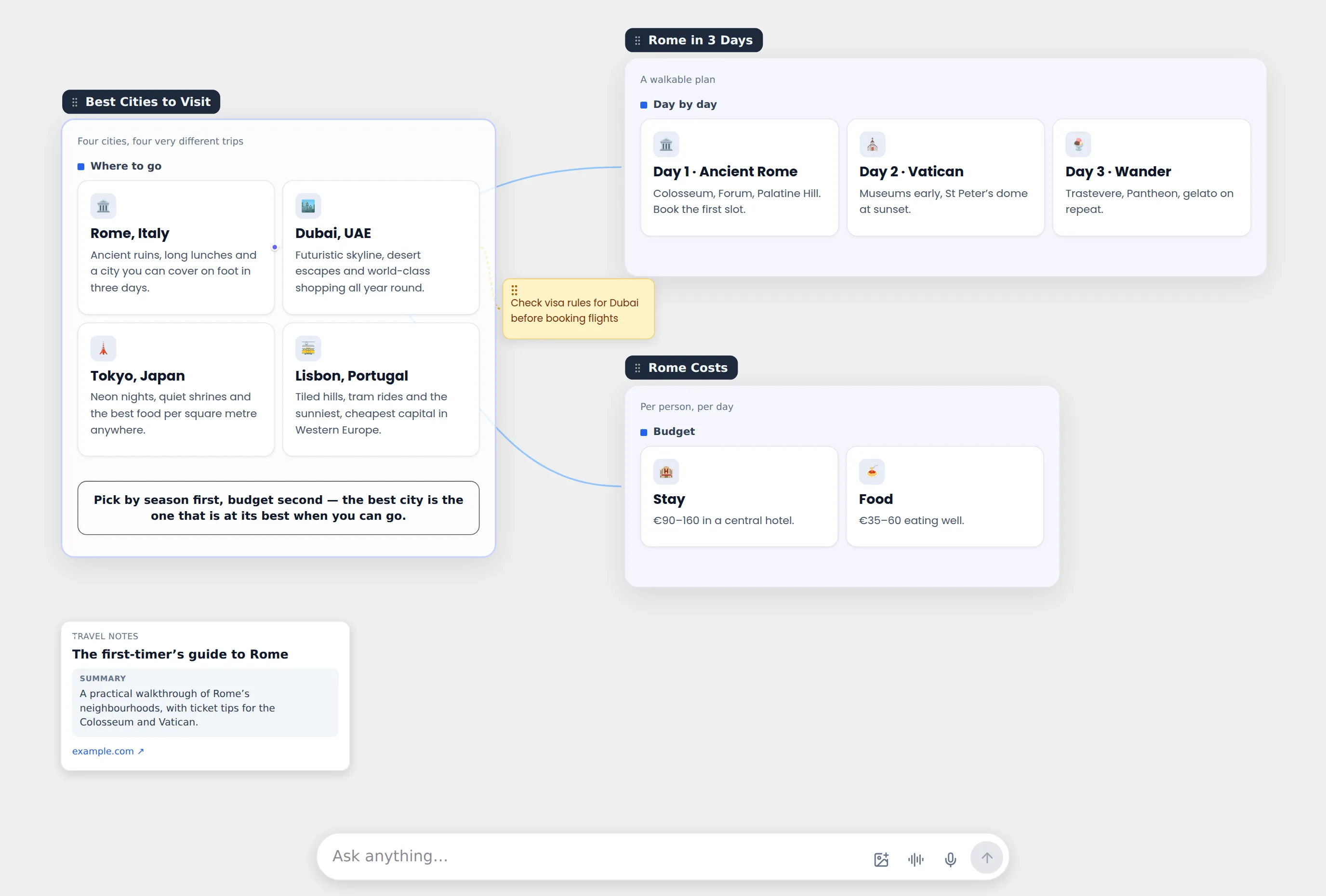
I am building the solution that will work for that future: a workspace where answers are not a wall of text, but a map you can see, question and shape. Add your email below for early access.
Get early access
Be first to try the visual workspace for how you think.